
This post contains affiliate links.
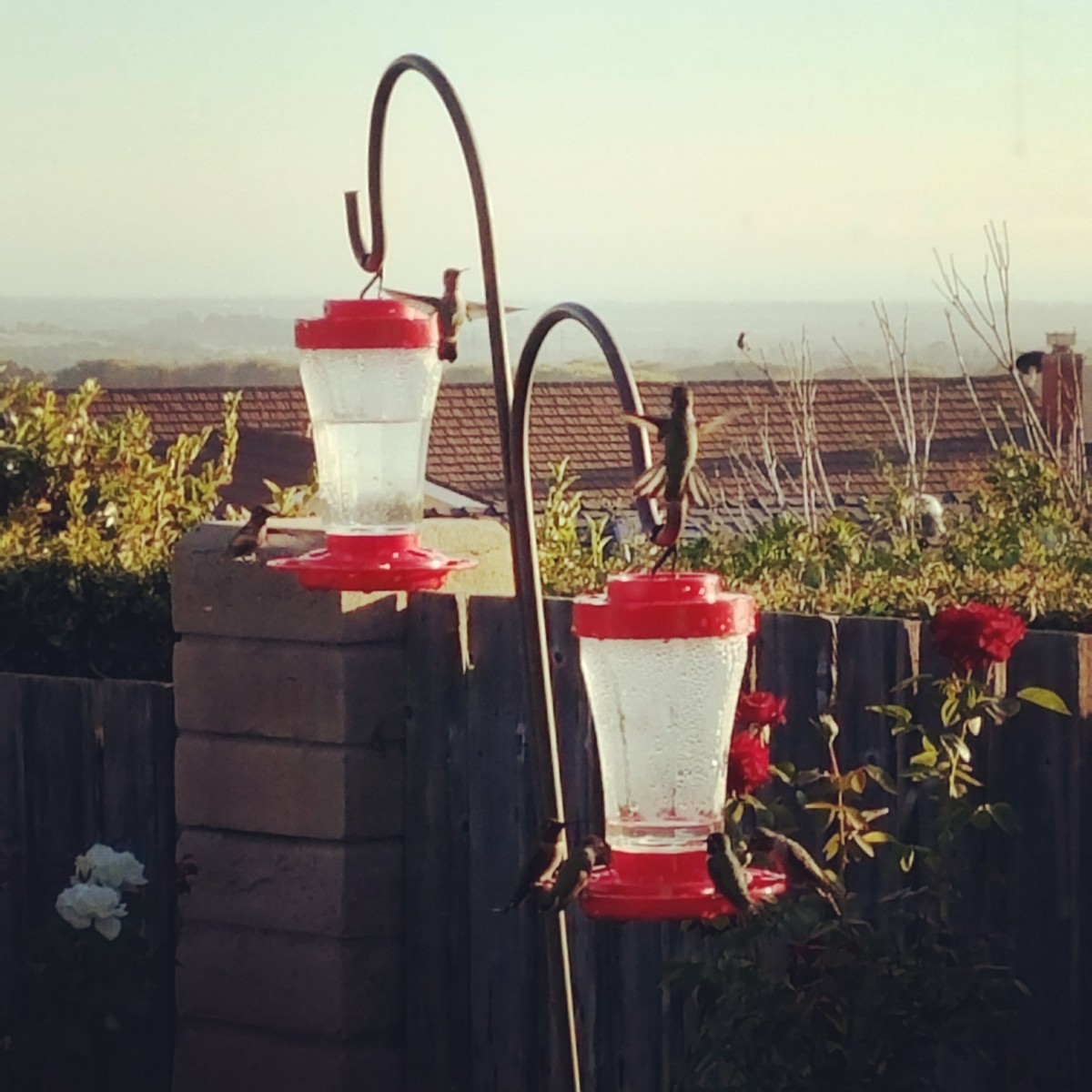
While in my backyard enjoying a delicious lunch with a friend, we noticed two hummingbirds twirling and dancing in mid air. This seemed out of the ordinary and caught our attention.
In the past, I have witnessed a full focused hummingbird flying into my backyard, drinking nectar and leaving. Everybody knows hummingbirds are fast aerodynamic birds. So I became curious and wanted to know what is the reasoning behind these dancing acrobats?
Do hummingbirds dance?
Hummingbirds can dance for many reasons.
- Having a protein snack
- Establishing a mating area
- Uniting in courtship behaviors
- Engaging in a territorial dance.
- Nest forming dance
Any of these flying habits can be seen as a hummingbird dancing.
Each type of dancing performed by these birds provides some insight into the life of a hummingbird.
Protein Snack Dance
Part of a hummingbird’s meal plan consists of consuming bugs for protein and they do not rely on a clear liquid nectar diet alone. They need protein to help build muscle and to fulfill their nutritional needs.
Have you ever noticed hummingbirds zig-zagging in your backyard like a pinball machine? They don’t seem to be chasing anybody out of their territory and they don’t seem to be (in love) twitterpated in finding a romantic partner?
Don’t be alarmed and think the hummingbird has lost their marbles.
If you look closely, you will find hummingbirds snatching small bugs out of the air such as spiders, gnats, flies and mosquitoes.
To get the required amount of protein for a healthy diet, an adult hummingbird must eat several dozen insects each day.
Experts say consuming spiders is the number one protein of choice for hummingbirds. They estimate up to 80% of a hummingbirds protein consumption is from spiders.
Hummingbirds frequently visit spider webs not only for fulfilling their protein consumption of spiders, but spider webs are the tool of choice in constructing and building nests.
If you compost in your backyard you will attract breed fruit flies or gnats which will entice hummingbirds to display their frequent protein-catching dance for you.
Hummingbird Mating Area Dance
Male hummingbirds establish breeding territories in preparation to entice a female for courtship.
They will establish their mating area in preparation for a mating dance and courtship by marking and protecting a large territory of nectar producing flowers and feeders.
Males will protect their food source and become territorial and chase away any unwanted visitors.
This is an exhausting exercise but well worth the benefits if successful.
Male hummingbirds will also protect a diverse foliage area. This includes having an advantage for a hide and seek dancing game with a female as well as providing potential nesting sites for expecting mothers.
The male’s job is to set up the mood and ambience for a pretty little lady.
Once the male hummingbird is triumphant in catching the eye of a female hummingbird he begins his hummingbird courtship dance.
Courtship Behavior Dance
The third way hummingbirds can look like they are dancing is by courting one another in anticipation for procreation. Hummingbirds will stop at nothing and don’t care if they look foolish to grab the attention of a potential beautiful female mate.
Male hummingbirds perform courtship dives before mating. There are two distinct courtship behaviors.
The first courtship behavior is produced by a dive display where a male hummingbird will fly as high as 130 feet up in the air and do a quick dive bomb next to or near a perched female. This dance shows off his athleticism, desirable traits and talent which may catch a female’s attention.
The second common courtship behavior is called the shuttle display. Just like the dive display a female is perched once again while the male will fly up behind her and swing his tail from side-to-side in an intimate dancing pattern while making buzzing calls or noises above her.
From Darwin’s theory of natural selection, female hummingbirds evaluate a males desirable biological traits through his strength in his athletic flying capabilities. Anything else that is subpar will be rejected.
This communication display can look like a hummingbird is dancing, but we now know it is just part of a courtship dance.
If the male hummingbird does everything correctly, his methods to impress a potential female will be ultimately successful.
Territorial Dance
Male hummingbirds are territorial by aggressively protecting their food sources, breeding territories and fighting for a female’s attention.
Do hummingbirds become territorial around feeders?
Male and female hummingbirds can be aggressive around feeders to defend their territory. Males will show hostility while defending a feeder in order to protect their food supply. Females will protect and defend a feeder if it provides them with adequate nectar to teach their offspring how to find food.
Since attracting a female is important, males will defend a large territory of highly prolific nectar producing flowers.
This advantageous trait is particularly valued to an admiring female since it signals to her that a suitor is able to provide her with the necessary food sources and most importantly to her offspring, which is imperative for survival.
Male hummingbirds will also be territorial around multiple hummingbird feeders. This is another form of food that shows to a potential female she will never go hungry.
You may experience seeing a fearless male hummingbird stand his ground and not be intimidated.
They will fight and harass each other like a pendulum ball swinging from side to side until the weaker male gives up and retreats.
This can be a fun activity to witness and can last as long as 2 minutes.
Male hummingbirds will look like the Energizer Bunny and will tirelessly continue to protect their feeding grounds.
By protecting and being territorial of their mating site, male hummingbirds will prove to other males that they are the king of the jungle.
Some of the worst offenders who show dire tempers are the Rufous and Ruby-throated hummingbirds.
Female hummingbirds can also look like they are dancing when they chase other males suitors away from their prime breeding or feeding locations.
Easy accessibility and proximity to nectar producing flowers is a big hurdle to overcome when teaching young how to feed themselves.
This activity to entice a female and chase away other suitors will pay dividends to maintain desirable genetic trait sustainability.
The times of the year you will see this extra typical aggressive behavior is in late spring or early summer during courtship season.
Nest Forming Dance
Female hummingbirds can be seen jumping up and down on a vine, branch or outdoor string of lights checking its durability of supporting a potential nest. They can also be seen adding spider silk and using their feet like a jackhammer to mold and shape the nest. These movements can be mistaken as dancing.
One year I caught this action when I noticed a particular hummingbird frequently accessing one of my outdoors string lights under the eave. This hummingbird would stay perched for a few seconds on the wire. At first I thought it was staking out a place to defend the feeder that was in close proximity.
However, as I continued to watch I saw the hummingbird repeatedly fly in and out from under the eave and perch in the same location performing these dance rituals.
I thought the hummingbird was completely mad. The behavior unusual and looked excessive.
Not until I continued to study the behavior did I realize this hummingbird was a female and was attempting to find the perfect location for a sturdy base to support her potential nest.
Female hummingbirds use spider silk as glue to construct and maintain the nest.
Gathering spider silk, she will use her beak like a spindle of a spinning wheel and quickly twirl in place to collect as much spider silk as possible.
The female will repeatedly return to the nest and rub her beak along the base and inside of the nest as she takes the spider silk and use it as an adhesive. This is the organic natural glue that keeps the nest together.
In between this routine she will mold her nest by rapidly stamping her feet along the floor of the nest to make sure the nesting materials and the spider silk mesh together perfectly.
This constructs a stable, secure and flexible foundation for her nest.
Witnessing nature in all of her glory was an informative first hand experience I will never forget.
Happy Hummingbird Watching!
Related Topics:
How much does a hummingbird weigh?
Hummingbird weight ranges from the Cuban Bee Hummingbird at 0.05 oz (1.4 gm) to Panama’s Violet Sabrewing Hummingbird at 0.42 oz (11.9 gm).
The four common hummingbirds in the backyards on the USA are the Ruby-Throated and Allen at (0.11 oz), Rufous (0.12oz), Anna (0.14 – 16oz).
Backyard Visitors participates in affiliate programs which compensate us for referring traffic.